

Home > About Metro > Business Interruption Fund
Business Interruption Fund
About
What is Metro’s Business Interruption Fund?
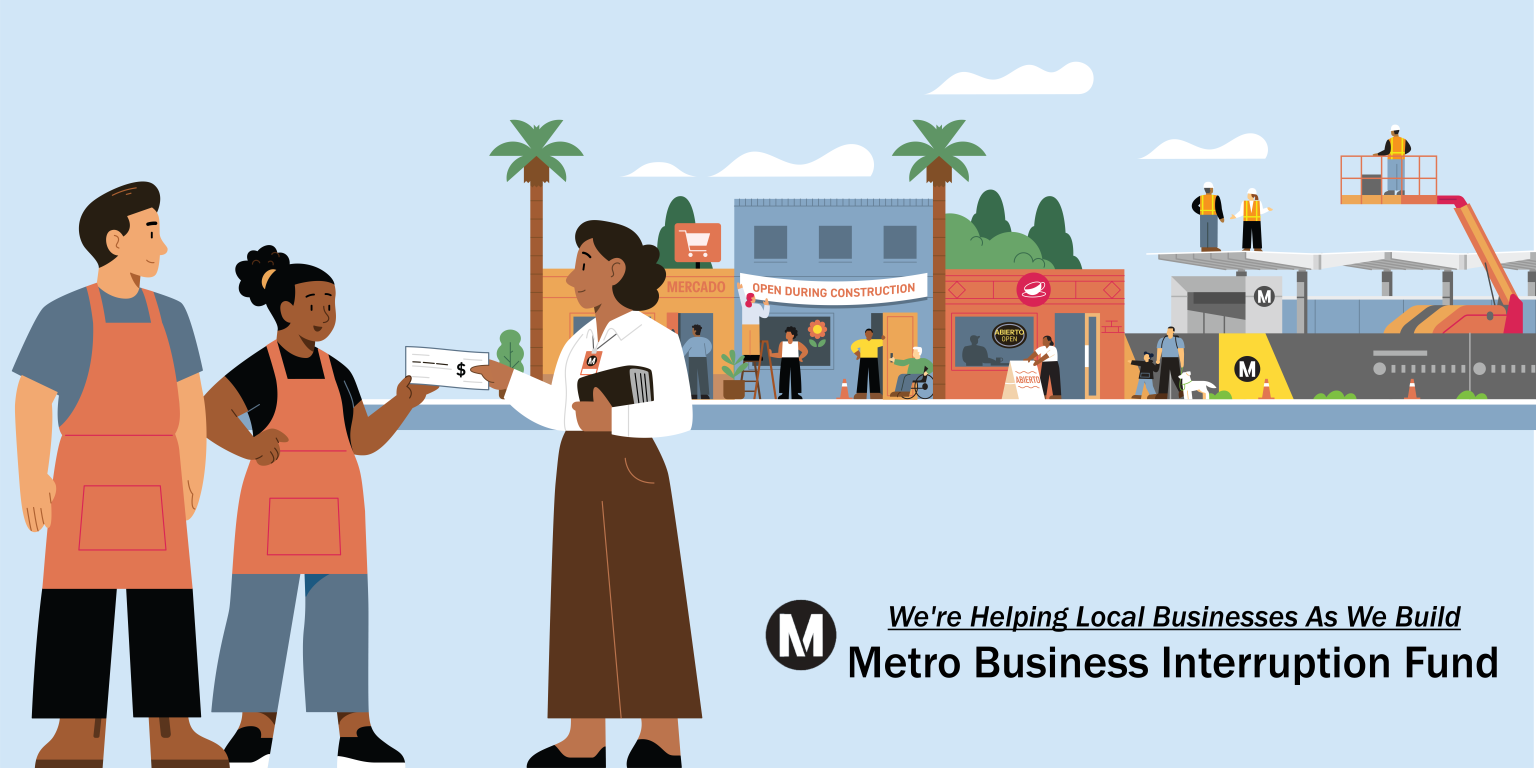
Metro’s Business Interruption Fund (BIF) is a construction mitigation program that provides financial assistance to small “mom and pop” businesses located along Metro project corridors that are impacted by construction.
Current Project Alignments:
- D Line Extension 1
- D Line Extension 2
- D Line Extension 3
- East San Fernando Valley Light Rail Transit Project
Past Project Alignments:
- Crenshaw/LAX (CLAX/K Line) Transit Project
- Regional Connector (Little Tokyo area)
- Regional Connector (2nd & Broadway segment)
Metro’s BIF is administered as a permanent program in partnership with Pacific Coast Regional Business Finance (PCR) as the Fund Administrator.
What is the purpose of the Business Interruption Fund?
Metro’s objective is to coexist with and enhance the communities we serve. As a trusted community builder, partner, and stakeholder, we are committed to ensuring that local small businesses continue to thrive both during and after the completion of construction.
The purpose of the Business Interruption Fund is to demonstrate that commitment through the award of grants to cover revenue losses tied to construction impacts.
What amount of financial assistance can an impacted business receive?
Businesses may receive up to $60,000 in grants per impact year based on actual verifiable revenue loss. Businesses may file multiple requests for financial assistance through the BIF as long as construction impacts persist.
If applicable, the financial assistance received must first be used to cover delinquent fixed operating expenses such as:
- Utilities
- Insurance
- Rent or Mortgage
- Payroll
Eligibility
How do businesses know if they are eligible to receive funds?
In order to be eligible for a grant, applicants must be:
1. Directly impacted by an eligible Metro Construction project.
- D Line Extension Section 1, Section 2 and Section 3
- East San Fernando Valley Light Rail Transit Project
2. Located within the eligible geographic area.
- Business must be immediately adjacent to a transit rail corridor or a designated construction staging or construction storage area, including a business located in a mall or strip-mall that is similarly situated.
3. Meet the definition of a small “mom and pop” business.
- Small business for the purposes of the BIF is defined as a for-profit business or non-religious, non-profit with 25 or fewer full-time employees.
4. Meet the technical qualifications to participate in the program, which include:
- Eligible businesses must be in continuous operation for at least two years along the corridor.
- Eligible businesses must have the ability to provide financial records (e.g. gross receipts, payroll taxes, bank statements or other financial information).
- Businesses must be solvent.
- Businesses must be in good standing with all local, state and federal taxing and licensing authorities.
5. Demonstrate a loss of business revenue directly related to the period of construction disruption.
Further Notes on Eligibility:
- Commercial property owners generally may apply for rental revenue loss from a tenant and/or other business losses. They may also file a claim based on revenue loss for mortgage, utilities, insurance, and other expenses as determined by the program administrator.
- Residential property owners are not eligible to apply.
Presumptive Eligibility Award (PEA)
The Presumptive Eligibility grant alternative offers up to $1,500 per impact year to small “mom and pop” businesses, including micro-businesses such as sidewalk and street vendors. The PEA has less restrictive documentation requirements than the typical BIF award, and targets businesses that may not have access to extensive financial records. The PEA has the same eligibility requirements as the BIF, requiring that applicants be either for-profit or non-religious non-profits located on a Metro project corridor for at least 2 years with 25 or fewer full-time employees.
How to Apply
How do I apply for financial assistance through the Business Interruption Fund?
There are “Four Easy Steps” to apply to the BIF:
Step 1. Visit the PCR website at this link, then click on the ”Start your Grant Request” button and follow the instructions.
Step 2. Complete and submit the online application.
Step 3. Schedule an appointment with a Business Advisor. The Business Advisor will contact you directly within two business days of submitting your application.
Step 4. Collect the required financial documents needed for your application. Your Business Advisor will assist you in this process as needed.
It’s that simple!
Applicants can also contact Bryan Miyamoto, Program Manager, at bryan.miyamoto@pcrcorp.org
Resources
Quarterly Status Reports
2023
2022
2021
- BIF Status Report 2021 Q4
- BIF Status Report 2021 Q3
- BIF Status Report 2021 Q2
- BIF Status Report 2021 Q1
2020
- BIF Status Report 2020 Q4
- BIF Status Report 2020 Q3
- BIF Status Report 2020 Q2
- BIF Status Report 2020 Q1
2019
- BIF Status Report 2019 Q4
- BIF Status Report 2019 Q3
- BIF Status Report 2019 Q2
- BIF Status Report 2019 Q1
2018
- BIF Status Report 2018 Q4
- BIF Status Report 2018 Q3
- BIF Status Report 2018 Q2
- BIF Status Report 2018 Q1
2017
- BIF Status Report 2017 Q4
- BIF Status Report 2017 Q3
- BIF Status Report 2017 Q2
- BIF Status Report 2017 Q1
2016
- BIF Status Report 2016 Q4
- BIF Status Report 2016 Q3
- BIF Status Report 2016 Q2
- BIF Status Report 2016 Q1
2015
Media Archive
Contact Us
Metro BIF Team
For information about the BIF Program, email bif@metro.net or contact Metro staff directly.
Angela Winston
Director, Business Interruption Fund
213.518.0884
Hellen Carcamo
Principal Transportation Planner
213.922.4619
Aaron Choi
DEOD Representative
213.922.5470
Pacific Coast Regional (PCR) BIF Team
For information about the BIF application process and/or to apply, contact:
Bryan Miyamoto
Vice President & BIF Program Manager
213.640.4627
Website: pcrcorp.org

