
K Line Northern Extension
Expanding fast, reliable rail service from the E Line north to Hollywood with new connections to four Metro rail lines and key destinations

Metro is planning an underground extension of the K Line from the E Line north to Hollywood. The new rail service will connect with Metro’s B, C, D, and E Lines, serving six of LA’s busiest bus corridors and improving access to jobs, healthcare, and entertainment.
Status
Thank you to everyone who followed the Metro Board meeting on March 26, 2026.
At the meeting, the Metro Board selected the San Vicente–Fairfax alignment as the Locally Preferred Alternative (LPA) for the K Line Northern Extension, a 10-mile underground rail line that will extend the K Line from Crenshaw/Expo to Hollywood, primarily along San Vicente Bl and Fairfax Av, with ten new stations and an end-to-end travel time of about 19 minutes between the Metro E Line and the Metro B Line in Hollywood. The LPA is contingent on the formation of an Enhanced Infrastructure Financing District (EIFD) by the City of West Hollywood in coordination with Los Angeles County to provide additional local funding to help build the project under the Early Project Delivery Strategy.
The board also passed a motion which keeps the project moving forward along with additional items and community engagement. The motion can be viewed here.
The selected route will serve major destinations such as Mid-City, Museum Row, Miracle Mile, The Grove, Original Farmers Market, Television City, Cedars-Sinai Medical Center, Rainbow District, Beverly Center, Pacific Design Center, West Hollywood’s Santa Monica Bl corridor and ultimately terminating at the Hollywood Bowl.
This project will help transform the system from a spoke-and-wheel to a grid, allowing riders to transfer between lines without going to downtown Los Angeles. When complete, it will connect Metro rail lines B, C, D, E, and K into a seamless, high- frequency, high-capacity network and provide convenient transfers to several of the busiest bus corridors in Los Angeles County.
Planning and Community Insights
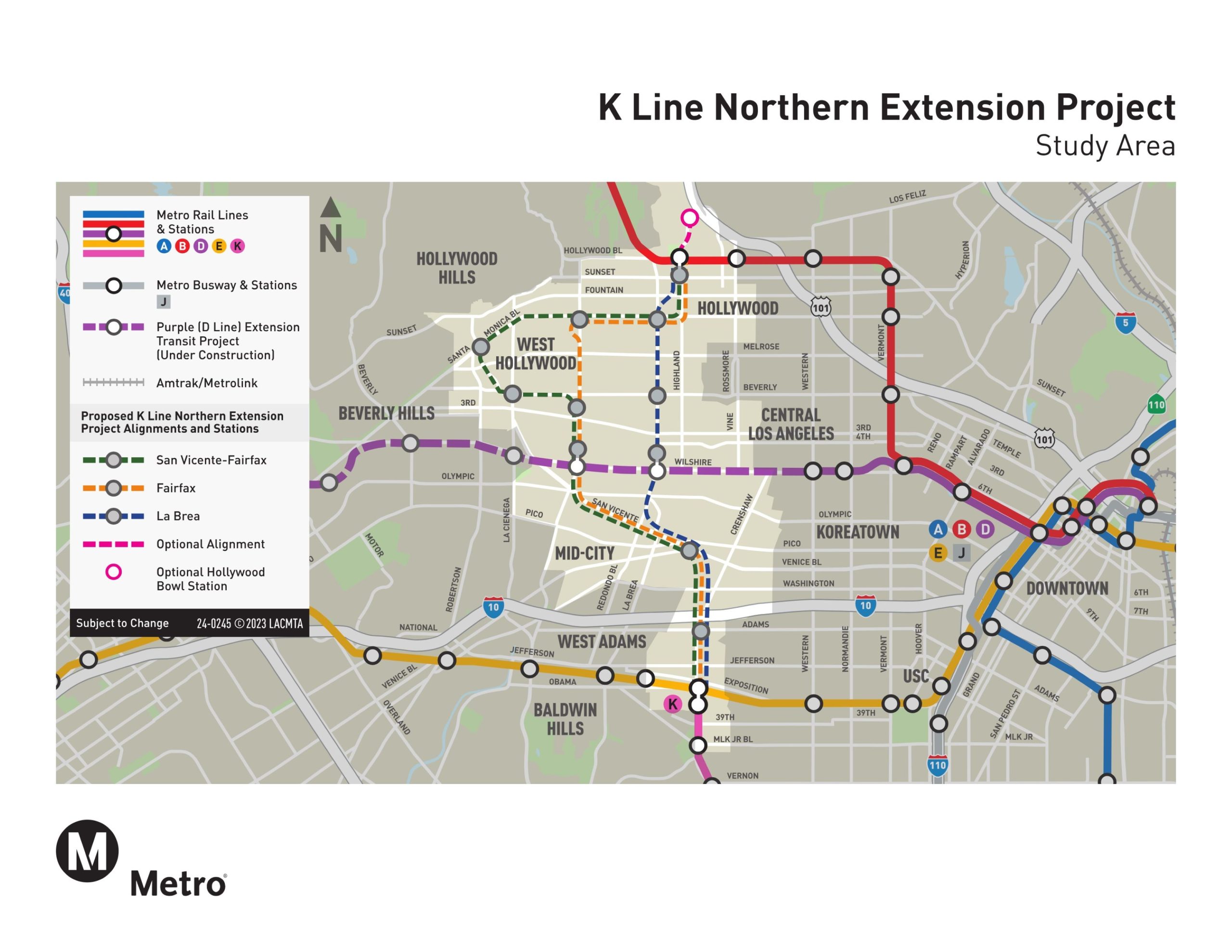
Project Map
The new rail service will connect with Metro’s B, C, D, and E Lines, serving six of LA’s busiest bus corridors and improving access to jobs, healthcare, and entertainment.
Project StoryMap
Metro’s updated Summer 2025 Story Map summarizes findings from the Mid-City Additional Alignment Analysis, Tunnel Safety, and Property Considerations reports that respond to community feedback raised during the Draft EIR period.
Recently Published Reports
In August 2025, Metro released three technical reports: Mid-City Additional Alignment Analysis, Tunnel Safety, and Property Considerations.
Project File Cabinet
Access reports, summaries, and key project documents in one place.
Locally Preferred Alternative (LPA) Frequently Asked Questions
Find answers to common questions about the project milestone for LPA selection.
Summary of Engagement
Review summaries of public comments received during the Draft EIR comment period and Metro's additional outreach efforts conducted in response to community feedback.
Fair Political Practices Commission Correspondence
Attached correspondence received.
Timeline
Anticipated Opening of KNE
Construction funding becomes available in 2041, with the extension anticipated to open for service between 2047 and 2049.
Metro Board to Consider LPA
Metro Board to consider selection of Locally Preferred Alternative and next steps.
Metro Prepares New Technical Studies
Metro conducted additional outreach, prepared and published new technical studies to address community concerns from Mid-City residents raised during the Draft EIR comment period including: Mid-City additional alignment options, property considerations, and tunnel safety. Metro hosted community meetings in Summer/Fall to share findings and continued engaging with Mid-City residents to gather feedback.
Metro Releases Draft EIR
Metro released the Draft EIR for public review and held hearings and meetings, receiving more than 1,300 community comments.
K Line Opens
The K Line opened, creating the foundation for its future northern extension.
Metro Launches Public Scoping
Metro launched the environmental review process with public scoping meetings to gather early community input.
Metro Board Directs Staff to Prepare Draft EIR
Metro advanced planning studies with Advanced Alternatives Analysis (AAA) Screening Study, further refining evaluation of potential alignments for a northern extension. Metro Board directed staff to prepare a Draft Environmental Impact Report (EIR).
Metro Prepares Feasibility/Alternatives Analysis (AA) Study
Metro prepared Feasibility/Alternatives Analysis (AA) Study, evaluating potential alignments for a northern extension of the K Line.
Voters Approve Measure M Funding
Voters approved Measure M, dedicating $2.24 billion for the K Line Northern Extension.
Construction Begins on the Original K Line
Construction began on the original K Line (then called the Crenshaw/LAX Transit Corridor Project).
Frequently Asked Questions
A Locally Preferred Alternative is the route selected by the Metro Board of Directors that best meets the project’s goals, objectives, and community needs, based on technical analysis and public input.
Metro is currently evaluating the K Line Northern Extension (KNE) project under California Environmental Quality Act (CEQA) and prepared a Draft Environmental Impact Report (EIR), which evaluates multiple alternatives. After a 60-day public comment period on the Draft EIR, including public hearings and community meetings, staff analyzed all feedback received and conducted additional technical analysis and community engagement in response to comments on the Draft EIR.
Metro has evaluated several alignment options in the Draft EIR (2024) and Mid-City Additional Alignment Analysis (2025), including:
- San Vicente-Fairfax Alignment: would extend the K Line underground approximately 9.7 miles north from the Metro E Line Expo/Crenshaw Station to the Metro B Line Hollywood/Highland Station.
- Fairfax Alignment: would extend the K Line underground approximately 7.8 miles north from the Metro E Line Expo/Crenshaw Station to the Metro B Line Hollywood/Highland Station.
- La Brea Alignment: would extend the K Line underground approximately 6.2 miles north from the Metro E Line Expo/Crenshaw Station to the Metro B Line Hollywood/Highland Station.
- Hollywood Bowl Design Option: would extend the K Line underground to the Hollywood Bowl, an alternate terminus to the Hollywood/Highland Station.
- Mid-City Alignment Options: based on community feedback, Metro evaluated 12 alignment options in Mid-City, to explore routes that could minimize subsurface easements below historic neighborhoods, and compared options based on potential subsurface easements, tunnel length, travel times, and changes to station footprints.
Since the 60-day public comment period on the Draft EIR ended in September 2024:
- Compilation of Comments: All written and oral comments were reviewed and compiled.
- Additional Technical Analysis & Community Engagement: In response to key concerns raised during the Draft EIR comment period, Metro conducted additional technical analysis and community engagement on tunnel safety, property concerns, and additional alignment options in Mid-City. These reports were published in Summer 2025.
- Mid-City-Specific Outreach: Metro organized additional outreach and engagement focused on concerns raised by residents in historic Mid-City neighborhoods, particularly around alignment options, property considerations, and tunnel safety, including community meetings and updated technical materials.
- Cost Benefit Analysis: Metro conducted a Cost Benefit Analysis (CBA) to compare the Draft EIR alignment alternatives based on expected costs and benefits, including a Weighted Benefits Analysis and a Benefit-Cost Ratio.
- Staff Evaluation and Recommendation for LPA: Staff has weighed multiple factors (e.g. technical analyses environmental impacts, ridership and project benefits, costs, constructability, funding, CBA findings), and public comments and stakeholder input to evaluate how the alignment options studied align with project goals and objectives to inform the LPA recommendation.
- Board Consideration: The Metro Board will consider the staff recommendation for the LPA and vote at a public meeting where the public may comment.
The selection of an LPA is based on technical and policy considerations, such as:
- Project goals and objectives
- Findings from the Draft EIR, including environmental impacts and proposed mitigation measures, and additional analysis completed in 2025 in response to community concerns on the Draft EIR
- Feedback received during the Draft EIR comment period and subsequent community engagement
- Project costs, funding availability, and financial feasibility
- Ridership projections and mobility improvements
- Input from stakeholders
- Constructability and operational feasibility
- Consistency with Metro policies and regional planning goals
- Proposed construction timeline
- Cost Benefit Analysis (CBA)
Get Involved
Help shape this project for good. We want to hear from you:
Contact the Project Team
Our team is here to support your questions and help you understand what this work means for your community. We welcome your questions and ideas as we explore early concepts and community priorities.
Channels are monitored to make sure you receive timely support.

Sign up for Project Updates
Register to receive detailed updates and essential information about our projects directly to your inbox. Stay informed and engaged as we progress, ensuring you have all the latest developments and key insights at your fingertips.

