|
|
|
|
|
|
|
|
Home > Projects & Programs > East San Fernando Valley Transit Corridor
Metro, in coordination with the City of Los Angeles, is conducting a transit study to evaluate ways to improve north-south transit opportunities in the east San Fernando Valley that offer connections to the regional transportation network.
In October 2011, a series of community meetings were held introducing this transit study which initially included only the Van Nuys Bl. corridor, between Ventura Bl and I-210. At the three meetings held in Van Nuys, Panorama City and Pacoima, comments were made urging Metro and the City to expand the corridor study area beyond Van Nuys Bl.
We are pleased to announce that Metro has now incorporated your recommendations into an expanded and newly named “East San Fernando Valley Transit Corridor” study. The Project Study Area has now been expanded to include Sepulveda Bl. and the Sylmar/San Fernando Metrolink Station as a northern terminus/origination point.
The Van Nuys and Sepulveda Bl. Corridors run through the heart of the eastern San Fernando Valley and connect diverse communities to their destinations every day. Both corridors are home to several destinations including schools, hospitals, large employers, the Van Nuys Civic Center, Auto Row, Sherman Oaks Galleria, and various shops and restaurants.
Initial alternatives being considered for both Van Nuys and Sepulveda Boulevards include:
An Alternatives Analysis process is being used to narrow down these potential alternatives, which will then be studied in more detail and evaluated based upon:
Metro wants to hear your vision for improving transit service in the East San Fernando Valley!
The Draft Environmental Impact Statement/Environmental Impact Report (Draft EIS/EIR) began with scoping providing the public with an opportunity to help shape the study. Four public scoping meetings were held:
The presentation at all the meetings was identical. You may also wish to view the web-cast of the March 21st meeting.
Scoping comments will continue to be accepted through May 6, 2013. Please look at the “Contact Us” box on the right hand side of the screen for more information.
We anticipate scheduling meetings to update the public on the progress of the study during the fall.
Metro and the City of Los Angeles, in coordination with the City of San Fernando and the Federal Transit Administration (FTA), are currently studying options for improving north-south transit service in the East San Fernando Valley. This set of Frequently Asked Questions is designed to provide you with basic information about the planning effort for the East San Fernando Valley Transit Corridor project. It will be updated periodically.
1. What is the East San Fernando Valley Transit Corridor?
Measure R, approved by Los Angeles County voters in 2008, allocated funding for a variety of transportation purposes including 12 transit projects. One of these is the East San Fernando Valley Transit Corridor that was also adopted into Metro’s 2009 Long Range Transportation Plan for Los Angeles County. The project is currently going through environmental analysis to evaluate options for improving north-south transit service in this area. See question8 for a study area map.
2. What is the process for studying this project?
Like most projects, the East San Fernando Valley Transit Corridor must go through an environmental analysis consistent with state and federal guidelines. This is the process that will eventually determine the project that will be built. For the East San Fernando Valley Transit Corridor, this process began with an Alternatives Analysis (AA), and is continuing with the preparation of an Environmental Impact Statement/Environmental Impact Report (EIS/EIR).
At each stage of the study process, the findings and staff recommendations will be presented to the Metro Board of Directors. The AA Study concluded in January 2013 when staff presented the Metro Board of Directors with the alternatives that are continuing for further analysis in the Draft EIS/EIR. At the end of the Draft EIS/EIR, the Board will be asked to select a “Locally Preferred Alternative” (LPA) for further study during the Final EIS/EIR. At the end of the Final EIS/EIR, the Board will be asked to certify the Final EIR and approve the project for design and construction.The project is also following federal procedures for environmental analysis so the Federal Transit Administration (FTA) is involved throughout the analysis and approves the EIS/EIR. The federal environmental analysis concludes when the FTA grants the project a Record of Decision (ROD). The FTA will consider that after the Metro Board of Directors certifies the Final EIR.
See questions 4, 6 & 7 for more information on the different study phases.
3. The project is located within the City of Los Angeles and also in the City of San Fernando. What role will each City play?
Unlike the Metro Orange Line, where Metro owns the right-of-way, this project is planned to operate on city streets. Therefore, the City of Los Angeles and the City of San Fernando are involved in the planning for this project.
The City of Los Angeles is serving as the project’s “co-lead” with Metro for this study. The City of San Fernando is also actively participating in the study effort. As the project advances, both the Los Angeles City Council and the San Fernando City Council will be asked for their support and concurrence.
4. When will this study be completed?
The full study is scheduled to conclude in 2015. The components of the study are discussed above in Question 2, and are estimated to occur as follows:
- Calendar year 2013/2014: Draft EIS/EIR
- Calendar year 2014/2015: Final EIS/EIR
5. When will I be able to ride the new service?
Plan, it is scheduled to be built and open for service in 2018.
6. What is an Environmental Impact Statement/Report (EIS/EIR)?
A combined EIS/EIR is prepared to satisfy both federal and state requirements for environmental review. The combined EIS/EIR identifies and analyzes the potential social, economic, transportation and environmental benefits and impacts associated with the construction and operation of the project’s “build” alternatives. It also analyzes and compares those to a “No-Build” alternative that assumes no changes beyond those already planned, and a “Transportation System Management” (TSM) alternative that incorporates low-cost capital and operational improvements to the existing transportation system such as improved bus service and signal timing. During the development of the Final EIS/EIR, it also identifies mitigations, if any, needed to address impacts.
7. What factors will be used to evaluate the various alternatives for this project?
Consistent with federal and state requirements for environmental review, the alternatives will be evaluated using the following criteria:
- Mobility Benefits and Impacts
- Regional Connectivity
- Cost-Effectiveness (such as capital and operating costs)
- Environmental Benefits and Impacts
- Land Use Considerations (such as job creation, development opportunities, and quality of life improvements)
- Community Input
- Financial Capability
8. Where will the project be located?
The study will evaluate a project that will mostly travel along Van Nuys Boulevard between the the Sylmar/San Fernando Metrolink Station and Ventura Boulevard. See question 12 for more information on the different routes being considered.
9. How was the study area determined?
Initially, various north-south routes in the San Fernando Valley were considered. It was decided to focus on the Van Nuys Boulevard corridor since it is the busiest north-south bus line the San Fernando Valley, and the seventh busiest in the entire Metro system. Based on input received in early 2012, Sepulveda Boulevard was also evaluated since it is only about one mile west of Van Nuys Boulevard. Input also resulted in including the Sylmar/San Fernando Metrolink Station as a potential northern origination/terminus for the project as it provides a connection to regional commuter rail service.
10. Will this be a bus project, a rail project or something else?
We don’t know yet. That’s part of what the study will evaluate utilizing the criteria discussed in Question 7.
11. What is the difference between Bus Rapid Transit (BRT) and Light Rail Transit (LRT)?
Both of these options are being evaluated for the East San Fernando Valley Transit Corridor Project.
- Bus Rapid Transit (BRT): This option could be similar to the Metro Orange Line where the service runs in its own exclusive right-of-way. BRT can also be designed as an exclusive lane either in the middle of the street or along the curb. It can also operate in mixed-flow traffic. Either way, this would be premier, clean fuel, compressed natural gas (CNG) bus service.
- Light Rail Transit (LRT): This is an overhead electric-powered rail system that runs in an exclusive right-of-way, similar to the Metro Blue, Green, Gold and Expo Lines.
See question 12 for information on the routes being studied for the BRT and LRT alternatives.
12. What are the routes and characteristics being evaluated for the BRT and LRT alternatives in the Draft EIS/EIR?
The Bus Rapid Transit (BRT) Alternative is considering the following:
- Alignment: Travel from Sylmar/San Fernando Metrolink Station south/east in mixed-flow traffic to Van Nuys Bl. Then south in dedicated right-of-way. Three options are being considered for a southern terminus:
- End travel in a dedicated right-of-way at the Van Nuys Metro Orange Line (MOL) Station. Buses could continue south via Van Nuys Bl to Ventura Bl in mixed flow traffic
- From the Van Nuys MOL Station, turn west on the MOL and terminate at the Sepulveda MOL Station.
- From the Sepulveda MOL Station, continue via Sepulveda Bl in a dedicated lane to Ventura Bl.
- Configuration: Median-running, at-grade in dedicated right-of-way combined with mixed flow traffic.
The Light Rail Transit (LRT) Alternative is considering the following:
- Alignment: Travel from Sylmar/San Fernando Metrolink Station south/east to Van Nuys Bl and then south to Ventura Bl.
- Configuration: Median-running, at-grade in dedicated right-of-way.
13. What about a Streetcar for this project?
Streetcars were evaluated and eliminated from further study. They are an overhead, electric-powered rail system, similar to the one in Portland, Oregon. Typically, streetcars run in mixed flow traffic, but can operate in an exclusive right-of-way. They are generally smaller and slower than LRT with more frequent stops. They did not offer significant improvement over existing bus service or perform well compared to BRT and LRT alternatives in this corridor.
14. Did you look at any other alternatives?
As a part of the process, the study must also evaluate two other options:
- No Build: This looks at the study area in 2035 without any new project. It incorporates existing roads, highways, transit services and facilities, as well as any other future projects that are included in the adopted Long Range Transportation Plan for implementation by 2035.
- Transportation System Management (TSM): This option considers low-cost capital and operations improvements to the transportation system such as improvements to signal timing, enhancing existing bus service, widening targeted intersections, etc.
15. How much money is available for the Project and what are the funding sources?
$170.1 million has been identified for this project in Metro’s 2009 Long Range Transportation Plan (LRTP) for Los Angeles County. These funds come primarily from the State of California’s Traffic Congestion Relief Program (TCRP) and Measure R. The TCRP provided money for Metro to “build a north/south corridor transit project that would interface with the East/West Burbank-Chandler corridor project (later named the Metro Orange Line) and with the Ventura Boulevard Rapid Bus project.” See Question 19 for more information about Measure R.
16. How much does each build alternative cost?
Based on the very preliminary analysis completed thus far, the BRT options are projected to cost $280-520 million. The LRT options are projected to cost $1.8-2.3 billion. These numbers all assume a planned opening date of 2018 for the project. They will be refined as the study progresses.
17. Why is there such a wide variation in the cost numbers?
LRT is generally more expensive to build than BRT due to the costs associated with constructing tracks and overhead power lines. Further, since this would be the first light rail project in the San Fernando Valley, projections also assume the costs to acquire land and build a storage and maintenance yard for the rail cars. The cost ranges for each travel mode are largely due to the variation in lengths, number of stations, forecasted right-of-way acquisition needs, and the very preliminary stage of the planning process. With additional project analysis, the cost projections will be refined further.
18. The LRT and BRT alternatives both cost more than $170.1 million. How are you going to build the project if you don’t have the money?
Like all of the other Measure R transit projects, the East San Fernando Valley Transit Corridor will likely need to seek additional funding to be able to be built in full. The project may also be built in phases to match available funding. These options will all be evaluated as the study progresses. As we get a better definition of the project, we may be better able to identify additional funding sources.
19. What is Measure R?
Measure R is the half-cent sales tax that was approved by Los Angeles County voters in 2008. The funds are being collected over 30 years for transportation purposes including several new transit and highway projects around the County, as well as bus and rail operations. The East San Fernando Valley Transit Corridor is one of the new transit projects included in Measure R. Measure R also provides funding to cities in Los Angeles County for transportation purposes.
20. I understand that the Canoga Extension of the Metro Orange Line was delivered under-budget. Can those funds be allocated to this project?
The Metro Board of Directors has the responsibility to decide how to reallocate additional funds that may remain once a project has been completed. In June 2012, the Board transferred some of the remaining funds from the Canoga Extension of the Orange Line to the East San Fernando Valley Transit Corridor. This did not increase the overall funding for this project but, instead, replaced funds that are no longer available due to the State budget shortfall.
21. How will the proposed East San Fernando Valley Transit Corridor Project improve transit connections to the entire region?
The East San Fernando Valley Transit Corridor intersects with the Metro Orange Line that connects to the Metro Red Line in North Hollywood. It also connects with Metrolink and Amtrak stations that provide linkages to regional destinations. The corridor connects with the Metro Rapid 750 (Ventura Bl) and the Metro Rapid 794 (San Fernando Bl).
22. Is Metro determining where the greatest number of people need to – or want to – travel?
Yes, one aspect of the analysis will be to determine travel patterns in the study area, including travel to key destinations in the corridor and beyond. Community input from individuals and organizations will provide important information about key destinations. The study will also complete a “trip distribution analysis” to better understand travel characteristics within the study area
23. How will the proposed East San Fernando Valley Transit Corridor Project work with the Sepulveda Pass Study/Project?
The Sepulveda Pass Project is another one of the Measure R projects. This future project is intended to improve connections between the San Fernando Valley and the Westside of Los Angeles. Based on the current funding schedule in the Long Range Transportation Plan, the Sepulveda Pass project is not planned until 2039. However, Metro is exploring alternate funding scenarios that may allow a project to be completed sooner. It is not yet known what kind of project this future improvement would be. Regardless, planners for the East San Fernando Valley Transit Corridor and the Sepulveda Pass project are working together to ensure coordination between the two projects.
24. Will the East San Fernando Valley Transit Corridor Project look at connections beyond the San Fernando Valley into West Los Angeles and/or LAX?
Yes, the study will evaluate travel patterns beyond the Corridor itself. By evaluating travel demand outside of the Corridor, Metro will have a better understanding of the number of riders that would be attracted to the new service. Metro will be conducting a separate study to evaluate possible improvements for the Sepulveda Pass Corridor, also a Measure R project (see Question 23). The East San Fernando Valley Transit Corridor is considering this future project in its planning effort.
25. Will the East San Fernando Valley Transit Corridor Project look at connections into Downtown Burbank?
In the adopted Long Range Transportation Plan, the East San Fernando Valley Transit Corridor is focused on improving north-south travel. A connection further east to Burbank would have to be studied separately. This would require direction from the Metro Board of Directors and funding would need to be identified.
26. Once the project is built, who will operate it?
Metro will operate the new project.
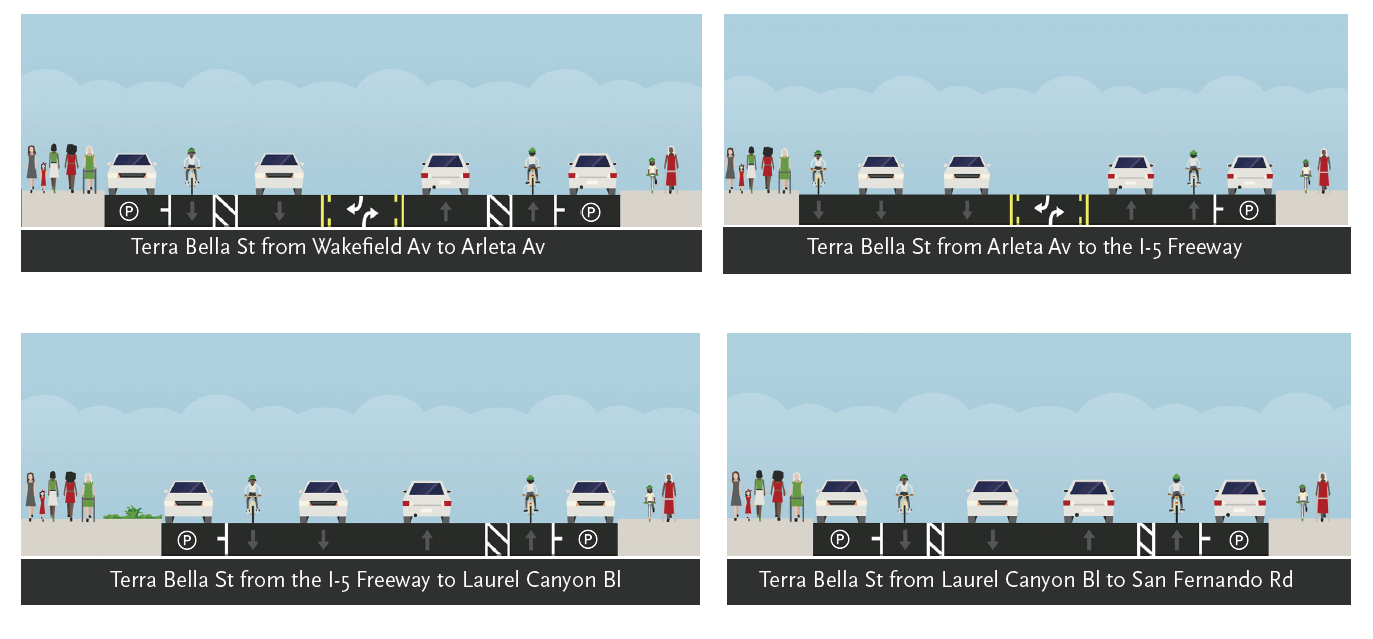
27. Will bike lanes and other bike facilities be included along the Corridor as part of this project?
As a part of the environmental study, we will look for opportunities to integrate bike facilities.
28. How will the location of stops or stations be determined?
Several factors are considered when determining station locations. BRT and LRT generally space stations approximately one mile apart. This improves overall travel times by allowing for greater travel speeds between stations, and less time stopped at stations. Locating stations to facilitate transfer opportunities to east-west bus lines is also important, as is serving key destinations and activity centers to maximize ridership potential.
29. Will on-street parking be affected?
Some of the options being evaluated may impact on-street parking in areas though it is too early in the process to identify specific locations or impacts, if any. This will be evaluated in detail as a part of the project’s environmental analysis.
30. Will corridor businesses be affected?
Similar to the previous answer on parking, it is too early in the process to identify the effects, if any, that the project will have on businesses. The EIS/EIR will analyze impacts of the project for businesses in the area.
31. Will a new storage and maintenance facility be needed?
If a Bus Rapid Transit (BRT) project is selected, the service could likely be supported with Metro’s existing bus maintenance facilities though they may need some modifications. If a Light Rail Transit (LRT) alternative is selected, a new facility would be needed to store and maintain the rail cars. This will be evaluated as a part of the environmental study.
32. Where would a rail storage and maintenance yard be located and how big would it be?
The environmental analysis will evaluate possible locations for a rail storage and maintenance yard. It would need to be located within a quarter mile of the route in an area zoned for industrial use. It would be 10-15 acres in size.
33. How will a new transit system help the area economically?
A new transit system has the ability to create new development opportunities along the corridor because it will provide increased regional connectivity as well as increased travel options. It will also allow riders to conveniently access retail centers along the East San Fernando Valley Transit Corridor, thereby stimulating increased sales revenues for local businesses. Opportunities for Transit Oriented Development (TOD) around stations can lead to providing service to residential and commercial projects, which in turn create job opportunities.
34. Why is it important that I participate in this study?
Community participation is a key component in planning any new transportation project. The environmental review process requires that public input and suggestions are evaluated. Your input will help us better understand the community’s transportation needs and priorities. Please make sure your voice is heard by attending one of our community meetings, joining the dialogue online, or sending us your comments by US Mail or e-mail. See question 38 for more information on how to do that.
35. How will public input be reflected in the study?
Public input is one of the factors that will be used to analyze the various alternatives being evaluated for this project. As discussed in question 10, public comments have already resulted in expanding the study area. Public input will be summarized and documented. It will also be shared with the Metro Board of Directors. Public input will be gathered throughout the study effort which also includes two “formal” public comment periods.
- Scoping: The work on the Draft EIS/EIR began with a “scoping period” from March 1-May 6, 2013. During this time, the public is invited to provide input on the issues they would like the study to analyze. Input can be provided in person during Scoping meetings or in writing.
- Draft EIS/EIR: Prior to consideration and action by the Metro Board of Directors, the Draft EIS/EIR will be released for a 45-day public review period. This is the time when the public can submit comments and questions for the record for further consideration by the Metro Board and for further analysis during development of the Final EIS/EIR, the next phase of analysis. Comments and questions may be submitted in writing and at public hearings that will be scheduled during this time. It is anticipated that the Draft EIS/EIR will be available for public review in Summer 2014.
36. What can I do to help spread the word?
There are several things you can do:
- Join our mailing list by sending your contact information to eastsfvtransit@metro.net.
- Follow us on Twitter and Facebook
- Share project information with your network of friends, neighbors, colleagues and family
37. Can you make a presentation to my community group?
We would be happy to schedule a presentation for your organization. Please contact us through any of the methods discussed in Question 36.
38. How can I contact you to ask a question, provide input or participate?
There are many public participation opportunities throughout this process.
You can e-mail us at eastsfvtransit@metro.net to ask a question, provide input or send us your contact information.
- Please attend any meetings we host in the community at key milestones. We will let you know when those dates are if you send your contact information to eastsfvtransit@metro.net.
- Follow us and participate on Twitter and Facebook
- Call us at 818.276.3233
- Text us at “ESFVTransit” to 25825
- Send a letter to: Walter Davis, Project Manager; Metro; 1 Gateway Plaza, 99-22-3; Los Angeles, CA 90012
Walter Davis, Project Manager
Metro
One Gateway Plaza, M/S 99-22-3
Los Angeles, CA 90012
Tel: 818.276.3233
SMS: text "esfvtransit" to 25827
Email:
eastsfvtransit@metro.net
For viewing MS Word, Powerpoint, and Excel documents - Download Adobe Acrobat Reader (free) or use Google Docs Reader (online)