Home > Riding > Riders with Disabilities


Riders with Disabilities


Riders with Disabilities

Quick Start

Quick Start

Metro strives to ensure that its services (including over 200 bus and rail routes) are fully accessible to all of our customers, including those with disabilities. To further assist those with visual impairments, Metro provides Braille-encoded and large type “Metro Flash Cards” for signaling the correct bus. For more information please call 213.922.7023.

Metro is also the primary funding source for Access Services Incorporated, the federally-required ADA paratransit service. This service is offered to individuals whose disabilities prevent them from independently using regular bus or rail service. It is comparable to fixed-route service and offers 24-hours-a-day curb-to-curb service. For more information, please call Access Services Incorporated at 1.800.827.0829.


Trip Planning

Tell the customer representative where you are starting from, where you want to go, and the time and day you want to travel. You’ll find out what bus or rail line to take and where to catch it.

You can also get customized itineraries 24 hours a day for all carriers in LA County using the Metro Trip Planner.

Metro Information Hours
Monday – Friday 6:30am – 7pm
Saturday & Sunday 8am – 4:30pm

Best times to call:
Monday – Friday 11am – 3pm
Saturday & Sunday 10am – 3pm

Our representatives can mail you a timetable listing all hours of service for your bus or rail line. Timetables are also available online in an accessible Portable Document Format (PDF).

Paying Your Fare

Cash Fares

The simplest way to pay your fare is with cash each time you board a bus or train. To receive the reduced cash fares, show your Medicare card, DMV Placard or Los Angeles County Transit Operators Association (LACTOA) Card. Riders with vision impairments may show a Braille Institute ID card.

You can also purchase transfers between lines operated by Metro and those operated by other carriers.

Disabled/Medicare Cash Fares:

Base Fare
$0.55
Required for each boarding

Metro-to-Muni Transfer
$0.10
Required for transfer to municipal lines; Not valid on Metro bus and Metro Rail

Freeway Express Add-Ons
Zone 1 - $0.30
Zone 2 - $0.60
Bus only freeway routes

Off-Peak Base Fare
$0.25
Weekdays 9am – 3pm and 7pm – 5am; All day on weekends and federal holidays

Metro Day Pass
$1.80
(TAP card required)
Good for local travel all day; Zone charges may apply on some lines

Warning: Failure to pay the proper fare is violation of Section 640 Penal Code and may result in a fine up to $250 and 48 hours community service.

Prepaid Passes

All passes are sold on TAP cards, durable plastic cards with electronic chips inside that you use again and again. Metro's Reduced Fare Program enables eligible riders to obtain special LACTOA/Disabled TAP ID cards and purchase monthly passes at reduced-rates.

Disabled/Medicare Pass Fares:

Monthly Metro Pass
$14
Good on Metro bus and Metro rail only

Monthly EZ transit pass
$35
Good on Metro bus, Metro Rail and many additional carriers

EZ Premium Stamp
Per Zone - $9.50
Good for long distance charges

Applications for LACTOA/Disabled TAP ID cards are available at Metro Customer Centers, in the TAP Users Guide for Riders with Disabilities. Applications are available inEnglish and Spanish. You will need proof of eligibility or a Medicare card. Completed applications must be accompanied by a photo, required documentation and a $2 processing fee.

When completed, applications can be mailed to Metro’s Reduced Fare Office, submitted at any Customer Center or mailed to the TAP Service Center as specified on each application.

Once you have your card, you can load it with a pass each month at Metro Customer Centers, at Metro Rail or Metro Orange Line ticket vending machines, online attaptogo.net, or at hundreds of neighborhood outlets; search “pass outlets” at metro.net for the location nearest you.

For complete information on obtaining and using your TAP card, please see the TAP User's Guide for Riders with Disabilities.

Helpful Contact Information

Metro Information
323.GO.METRO (266.6883) or 323.GO.METRO (466.3876)

Wheelchair Lift Hotline
1.800.621.7828

Lost and Found
323.937.8920

TAP Reduced Fare Office
1.866.TAPTOGO


Rail Access

Rail Riding Tips

Wheelchair on Metro Rail

All Metro Rail lines are accessible to persons in wheelchairs. Every station has either a walkway/ramp or elevator from the street level to the boarding platforms. In the event the elevator at the station where you want to board is out of order, you may take a bus to the next station free of charge.

  1. Boarding and exiting the train – It is recommended, but not required, that persons in wheelchairs back into and out of rail cars to avoid encountering problems with the gap between the platform and the rail car. Each rail car can accommodate two to four wheelchair patrons. The door nearest the designated wheelchair location will display the blue universal wheelchair symbol. If you cannot use the area designated for wheelchairs, position yourself to avoid blocking the doors. Please do not block the train operator’s cab door.
  2. Securement on the train – There are no securement devices on rail cars. Passengers using mobility devices such as a wheelchair should use one of the handholds inside the rail cars and set the brakes or turn off the power on their chairs while riding the systems.
  3. Turnstiles – Many station entrances have turnstiles which provide a point for validating TAP cards. Please use the entrance designated for persons with disabilities for wheelchairs and oversize items at all such stations, located on the left side of the bank of turnstiles and marked with the blue universal wheelchair symbol.

Accommodations for Riders with Vision Impairments

  • Braille and tactile signs are posted at station entrances to identify the station. Additional signs are posted on the sides of stairs and escalators adjacent to the platform in all subway stations to indicate the direction the train is traveling at that platform.
  • Care should be taken when approaching the edge of the platform. Truncated domes to alert passengers with visual impairments are installed on all platform edges. In addition, flexible yellow warning poles are installed on platforms to provide barriers that block the gap between rail cars when trains are in the station.

General rail riding tips


Bus Access

Bus Riding Tips

Wheelchair Accommodations

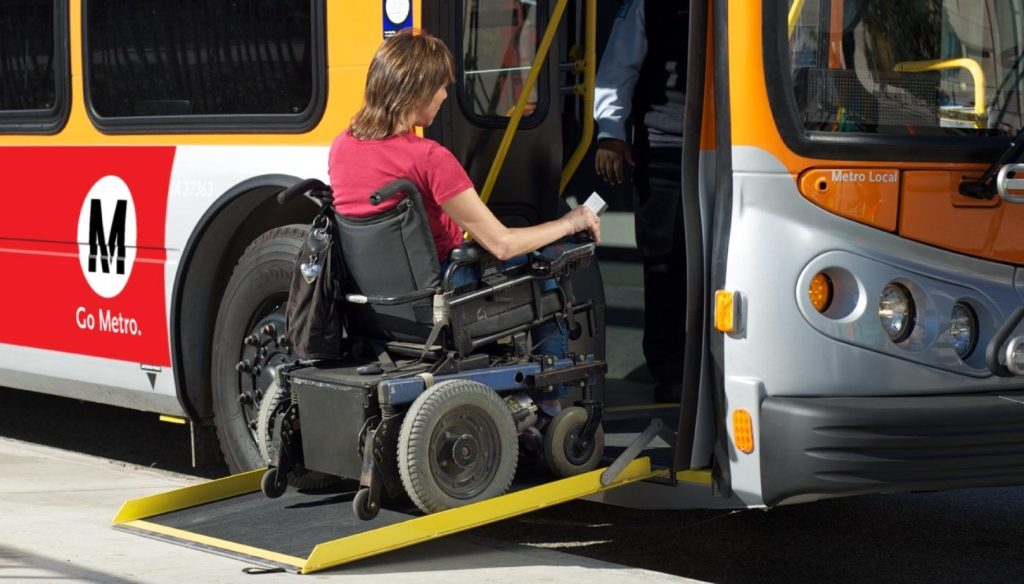
Metro buses can accommodate all types of wheelchairs, including three-wheel scooter-chairs, power chairs and small four-wheel chairs. The general requirement is that it must fit on the lift and be able to maneuver to the wheelchair securement area.

Specifically, lifts, ramps and securement areas on Metro buses can accommodate mobility devices up to 30 inches wide and 48 inches long. An attendant may accompany the wheelchair passenger on the lift providing the combined weight does not exceed 600 pounds.

  1. Boarding the bus – Bus operators will offer to assist each wheelchair passenger in boarding the bus, reaching the securement area and securing the chair. Wheelchair passengers should enter the lift or ramp slowly and while on the lift, secure their chair so that it will not roll when the lift is in motion. Be aware of items hanging outside of the chair (bags, backpacks, baskets or other items) and make sure they are not in the way while boarding.
  2. Securement on the bus – Metro uses a strap system mounted on the floor that can secure a variety of mobility devices.
  3. Safety strap program – Metro offers free expert pre-marking of tie-down locations on mobility devices and safety straps for securement points. Both enable faster securement and release aboard buses. For the free pre-marking or installation of safety straps, contact 213.922.8800. See the Safety Straps for Mobility Devices brochure for complete details.
  4. Securement areas – Metro policy requires that the operator ask other passengers sitting in the wheelchair securement area to move when a wheelchair passenger boards. The operator will request other passengers to give up their seats, but cannot force them to move.
  5. Mechanical failures – In the event there is a problem with the lift or ramp on a bus, the operator will contact Bus Operations Control for a supervisor or another bus to assist the patron using the mobility device. On most Metro routes, another bus with an operating lift or ramp will arrive at the stop in less than 30 minutes.

Accommodations for Riders with Vision Impairments

  • Operators call out their route number when pulling up to a stop used by multiple bus lines when a person with a visual impairment is waiting. Special Metro Flash Cards with Braille and large print are available at no cost to assist riders with visual impairments in letting bus operators know which route they want. To obtain a Metro Flash Cards, please call 213.922.7023.
  • Operators announce all transfer points, major intersections, points-of-interest or any other stop upon request. They also make periodic announcements of stops along the route to enable passengers to determine when their stop is approaching. Most Metro buses are equipped with automated systems which announce all stops.

General bus riding tips


Elevator Alerts


Riders with Disabilities


Metro's Accessibility Advisory Committee (AAC) meets monthly in the Gateway Plaza Conference Room, 3rd floor in the Metro Headquarters building in downtown Los Angeles. Accessibility Advisory Committee Agendas are available in alternative formats upon request; Please Call 213/922-2403 or 213/922-3003. Live captioning provided at every Accessibility Advisory Committee Meeting.


For viewing MS Word, Powerpoint, and Excel documents - Download Adobe Acrobat Reader (free) or use Google Docs Reader (online)

TRANSIT INFO: 323.GO.METRO (323.466.3876) STAY CONNECTED: