Home > Projects & Programs > Westside Subway Extension


Westside Subway Extension


Overview

Work is proceeding on the long-envisioned subway to the Westside which has been discussed in Los Angeles for the better part of the last half-century. When built, the subway will provide a high-capacity, high-speed, dependable alternative for those traveling to LA’s “second downtown.” The area includes key job destinations such as Miracle Mile, Beverly Hills, Century City and Westwood including the UCLA campus. Over 300,000 people travel into the Westside every day for work from areas throughout the County.

Metro is currently conducting a Draft Environmental Impact Statement/Environmental Impact Report (Draft EIS/EIR) for the Westside Subway Extension. We are studying alternatives that would connect with the current terminus of the Metro Purple Line at Wilshire/Western, as well as a potential connection to the Metro Red Line at Hollywood/Highland. In fall 2010, the Metro Board of Directors is expected to consider the Draft EIS/EIR and select a “locally preferred alternative” (LPA). The LPA is the project that will proceed through final environmental review, preliminary engineering and also compete for federal “New Starts” matching funds. The Long Range Transportation Plan for Los Angeles County commits $4.2 billion over the next 30 years to the Westside Subway.

Please look through our web site for information about what we have been studying, information we have shared with the public, how to follow the continuing planning work, and how to share your thoughts and questions with us.


Background

Metro Initiates Draft EIS/EIR

On January 22, 2009, the Metro Board of Directors authorized preparation of a Draft Environmental Impact Statement/Environmental Impact Report (Draft EIS/EIR) for the Westside Subway Extension. They also approved the results of the Alternatives Analysis (AA) Study for the Metro Westside Subway Extension. The AA recommended two build alternatives for further evaluation in the Draft EIS/EIR:

  • Metro Purple Line Subway Extension via Wilshire Blvd. to Santa Monica; and
  • Metro Purple Line Subway Extension via Wilshire Blvd. to Santa Monica plus Subway Extension from Metro Red Line Hollywood/Highland Station via Santa Monica Blvd.

In addition, the Draft EIS/EIR must evaluate a “no-build” and a Transportation Systems Management (TSM) alternative.

Background

Over the past 30 years, tremendous population and employment growth, worsening congestion, changing land uses and traffic patterns, as well as Metro’s challenge to meet transit demand, have led to the need to improve mobility in the Westside Corridor.

In fall 2007, Metro began an Alternatives Analysis Study (AA) for the Westside Extension Transit Corridor Study. Over a year-and-a-half, the AA considered whether a transit improvement was needed in the area and evaluated various types of transit improvements and alignments. The AA was completed in the winter of 2008/09.

Draft EIS/EIR Process

The purpose of the Draft EIS/EIR process is to further refine the project alternatives, assess the impacts of those alternatives both during construction and once the system is operating, and to look at possible mitigation measures.  Issues to be addressed as the alternatives are refined include decisions about station locations and ultimate alignments.

At the conclusion of the Draft EIS/EIR process, Metro will recommend a Locally Preferred Alternative (LPA). The LPA will identify the project that will move forward into the Final EIS/EIR process. Elements to be considered prior to identification of the LPA are defining the initial Wilshire Blvd. segment(s) as well as future segment(s), specifying station details, examining the cost effectiveness of various segments, and the timing and funding for the implementation plan.

The Draft EIS/EIR process took place in April 2009 with public scoping meetings which provided the public an opportunity to comment on the project purpose, alternatives, and the potential effects of construction and operation that should be considered in the Draft EIS/EIR. Metro and the Federal Transit Administration (FTA) will be preparing a joint document that meets the requirements of both the National Environmental Policy Act (NEPA) and the California Environmental Quality Act (CEQA).

The Westside Subway Extension project is slated to receive partial funding from Measure R, the half-cent sales tax increase approved by voters in November 2008.

Study Area

The overall study area covers 38 square miles and extends from the existing Metro Rail Hollywood/Highland and Wilshire/Western Stations to the Pacific Ocean. The northern boundary of the study area follows the base of the Santa Monica Mountains along Hollywood, Sunset and San Vicente Blvds. The southern boundary follows Pico Blvd.  

Draft EIS/EIR Study Schedule

Public Scoping Meetings
Scoping Public Comment Period Closes May 7, 2009
Ongoing Community Update Meetings Approximately Quarterly
Public Hearings on Recommended Locally Preferred Alternative Summer 2010 (anticipated)
Metro Board Adoption of Locally Preferred Alternative Fall 2010 (anticipated)


More Information

Please go to Reports & Info to see Study information.  If you have questions or want to be notified of upcoming meetings, please go to Contact Us.


FAQ

Introduction

Metro is currently evaluating the Westside Subway Extension through the preparation of a Draft Environmental Impact Statement/Environmental Impact Report (Draft EIS/EIR). This work began in early 2009 and should continue till fall 2010 when the Metro Board of Directors is expected to consider the results of this evaluation. Prior to the Draft EIS/EIR, we conducted an 18-month Alternatives Analysis (AA) Study for the Westside Extension. In January 2009, the Metro Board of Directors approved the AA Study and authorized proceeding with the Draft EIS/EIR.

The Metro Board of Directors will make the decisions about what the project is that will be designated for final environmental review, and what will ultimately be built. However, as the evaluation has proceeded, various options have been eliminated from further consideration and are no longer being evaluated.

This set of “Frequently Asked Questions” is intended to provide information on the work that has already occurred and is continuing. It will be updated throughout the ongoing study.

Other public documents that have been developed during the Draft EIS/EIR and the earlier AA Study are also available at "Reports and Info".

Subjects discussed here include:

The Study

Cost & Funding

Alternatives Being Studied

Ridership & Travel Time

Modes, Alignments & Stations

Subway Construction, Construction Impacts & Mitigation Measures

Construction & Operations Under & On Private Property

Safety

System Connectivity

Station Area Parking

Schedule & Phasing

Public Involvement

The Study

1. What is being studied? 

The Draft Environmental Impact Statement/Environmental Impact Report (Draft EIS/EIR) is evaluating five different alternatives. All of the alternatives have a common subway segment on Wilshire Boulevard extending to Westwood. One alternative also extends to Santa Monica, one alternative adds a possible branch through West Hollywood, and one alternative includes both the extension into Santa Monica and the possible branch through West Hollywood. Maps of these alignments are available here.

As required, the Draft EIS/EIR is also evaluating a No-Build Alternative and a Transportation Systems Management (TSM) Alternative.

2. What is the purpose of the Draft EIS/EIR and what will it study? 

The purpose of the Draft EIS/EIR is to study the potential impacts of construction and operation, and to evaluate measures to avoid, minimize and mitigate adverse impacts of the project. Examples of impacts to be studied:

Operation and construction

Traffic and parking

Land use and development

Displacement and relocations

Community and neighborhood impacts

Visual and aesthetics

Air quality

Noise and vibration

Ecosystems and biological resources

Geotechnical, seismic and hazardous materials

Hydrology and water quality

Energy

Climate change

Historic, archaeological and paleontological impacts

Parklands

Economic and fiscal impacts

Safety and security

Growth inducing impacts

Environmental justice

Cost and financial analysis

The Draft EIS/EIR will evaluate the alternatives against required environmental criteria, as well as criteria used by the federal government for providing matching funds.

3. What is the difference between the earlier Alternatives Analysis (AA) and the Draft Environmental Impact Statement/Environmental Impact Report (Draft EIS/EIR) currently underway? 

The AA Study assessed the need for a transit improvement on the Westside and evaluated a wide range of options to meet this need. We evaluated 17 different alignment options, various transit modes including heavy rail, light rail, bus rapid transit and monorail, as well as looked at alternatives that ran at ground-level, above-ground and below-ground.

The AA Study provides a great deal of important information to the Draft EIS/EIR, but does not result in sufficiently identifying a project that is ready for final environmental clearance, to begin engineering, or that can compete for federal “New Starts” funds. The Draft EIS/EIR will identify a project that meets these goals. It incorporates and references the work of the AA Study, but evaluates the alternatives in much greater detail including exact locations for proposed stations, station entrances and tunnels, as well as potential impacts from the project and its construction.

4. When will Metro recommend the final mode, alignments, and station locations?

At the conclusion of the Draft EIS/EIR phase, Metro staff will recommend a Locally Preferred Alternative (LPA), which will reconfirm the mode, and recommend the alignment, length, and station locations that will move forward into the Final EIS/EIR. The LPA will incorporate the project that can be built and operated within expected funding and best compete for federal “New Starts” matching funds. It will likely include defining the initial Wilshire Boulevard segment(s) as well as the timing for subsequent segments of the LPA. It will specify station location and entrance details, examine the cost effectiveness of various segments, and the timing and funding for an implementation plan. The Metro Board of Directors is expected to consider the Draft EIS/EIR and the staff recommendations in the fall of 2010.

[Top]

Cost & Funding

5. How much will the project cost?

The Draft EIS/EIR is updating the cost estimates for construction of the subway. The Alternatives Analysis (AA) estimated that the full Wilshire Subway, all the way “to the sea,” would cost $6.1 billion (in 2008 dollars). The combined Wilshire/West Hollywood Subway would cost $9 billion (in 2008 dollars).

6. How will the Subway be funded and where will money come from? Has the passage of Measure R, in November 2008, changed the prospects of the implementation of the subway?

The Subway will be funded by a combination of local and federal dollars. Prior to the passage of Measure R in November 2008, there was no funding available for the Westside Subway Extension. Measure R provides the local funds for the Wilshire alignment of the Subway to Westwood. The Measure R dollars will be used as local match to seek federal “New Starts” funds.

7. How much money is available for the Subway?

Metro’s Long Range Transportation Plan (LRTP) adopted in October 2009 commits $4.2 billion in 2008 dollars, from both local and federal sources for the Subway. Measure R, which provides the local money, allocates money to the Subway and various other projects over 30 years.

8. How much of the proposed subway would this amount of funding build?

The $4.2 billion provided by the adopted LRTP and Measure R plan, including the anticipated federal “New Starts” matching funds we are pursuing, will provide enough funding to extend the subway from Wilshire/Western to the vicinity of the I-405/San Diego freeway.

[Top]

Alternatives Being Studied

9. What are the alternatives being studied in the Draft EIS/EIR?

We have identified two alternatives that could be built within the funding provided by the adopted LRTP and Measure R plan and three alternatives that go beyond those adopted plans. The alternatives retained for further analysis during the Draft EIS/EIR are:

Alternatives that could be built & operated within adopted LRTP/Measure R funding:

Alternatives beyond adopted LRTP/Measure R funding:

The Draft EIS/EIR is also evaluating a required “No Build” alternative as well as a Transportation Systems Management (TSM) alternative.

10. If anticipated funding is sufficient to build only along Wilshire to the Westwood area, why are you studying a subway all the way “to the sea” and a West Hollywood alignment?

As a part of the Draft EIS/EIR, we are required to evaluate all possible alternatives against required criteria regardless of funding constraints. At the conclusion of the Draft EIS/EIR, we will recommend a Locally Preferred Alternative (LPA) to the Metro Board of Directors (see Question 4). The LPA must be a project that can be built within anticipated financial resources. Once adopted by the Metro Board of Directors, the LPA is the project that will compete for federal “New Starts” funds and proceed through final environmental clearance and engineering. The LPA must be eligible and highly competitive for federal "New Starts" funding including being able to be built and operated within projected available funding. Segments beyond what can currently be funded could be recommended to be studied in the future.

[Top]

Ridership & Travel Time

11. How many people will ride the Westside Subway Extension?

Preliminary ridership projections were included in the adopted AA Study. These numbers are being updated as a part of the Draft EIS/EIR and preliminary projections should be available in Spring 2010.

12. How long will it take to travel to the Westside on the Subway from various destinations around LA County?

The table below, taken from Metro’s September 2008 community update presentation, illustrates the projected travel times to Westwood/UCLA using the Westside Subway Extension. Travel times to Westwood/UCLA will improve by about 30-60% from various parts of the region compared with existing transit schedules. It should also be noted that travel times on the Subway will remain constant over time, whereas bus and auto travel times on surface streets vary depending on traffic conditions and are expected to degrade over time as congestion increases.

Chart

[Top]

Modes, Alignments & Statons

13. What Other Travel Modes and Alignments Have Been Considered?

The AA Study evaluated various transit modes including:

• Bus rapid transit operating in the street; 

• Light rail operating below ground, above ground & in the street; 

• Monorail operating above ground; and 

• Heavy rail operating below and above ground.

The AA Study concluded that a heavy rail, below ground subway (similar to the Metro Red and Purple Lines already operating) was the most appropriate mode to provide the transit capacity required to meet the forecast travel demands in this corridor.

The AA Study also evaluated a total of 17 different alignments over the 18-month study. This included evaluating options where the alignment through West Hollywood would precede the Wilshire alignment, and options that deviated off of Wilshire Boulevard. The AA Study recommended two Build alternatives that became the basis of the analysis in the Draft EIS/EIR. These have now evolved into five alternatives that are currently under evaluation (see Question 9).

Information from the AA Study is available here.

14. Wouldn’t an above ground option be cheaper to build as it would avoid the costs of tunneling?

In many corridors, building above ground can be cheaper. This is not always true, especially in already dense, heavily-traveled corridors like the Westside. Costs escalate when you account for the real estate costs to obtain space needed to create station entrances or to build other systems at street level that are needed for the project. There would also be additional costs incurred to mitigate the traffic impacts of the travel lanes that would be lost along the alignment to accommodate the support structure for an elevated system. During the AA study, we also determined that any above ground option would overwhelm the current streetscape in this corridor.

More information about above-ground options in the Westside Corridor can be found in the May 2008 community presentation.

15. Where are stations being considered for the Subway?

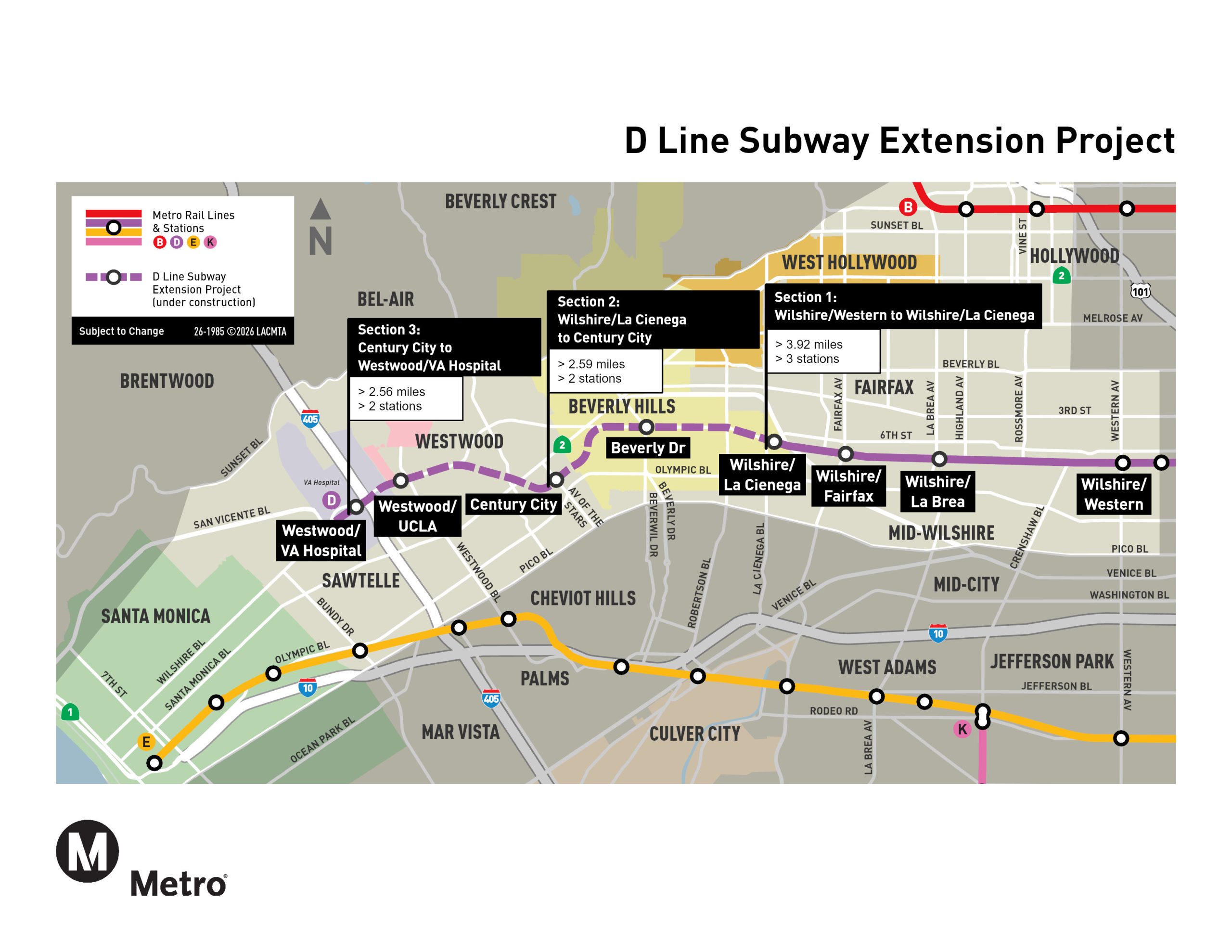
• For the Wilshire Subway, extending from the current terminus of the Metro Purple Line at Wilshire/Western, the Draft EIS/EIR is evaluating stations at Crenshaw (optional), La Brea, Fairfax, La Cienega, Rodeo, Century City, Westwood/UCLA, Westwood/VA Hospital, Bundy, 26th Street, 16th Street & 4th Street.

• For the combined Wilshire/West Hollywood Subway, the Draft EIS/EIR is evaluating all of the stations identified for the Wilshire Subway. For the West Hollywood component, we are evaluating connecting to the current Metro Red Line station at Hollywood/Highland with stations under Santa Monica Boulevard at La Brea, Fairfax, San Vicente, as well as a station in the Beverly Center area.

16. When and how will the decision be made on the optional Crenshaw Station?

As a part of the Draft EIS/EIR, we are compiling data about the optional Crenshaw Station. Some of this will include estimating boardings at the station, boardings on the Subway with and without the station, costs of building the station, and community impacts. Community input will also be an important factor. The decision about whether or not to include the Crenshaw Station may be made at the conclusion of the Draft EIS/EIR. If it is determined at that stage that further analysis about that station is necessary, we could continue to evaluate it during the Final EIS/EIR and make the decision at the end of that phase. The Metro Board of Directors will make the decisions about what will proceed into final environmental review and what will ultimately be built.

17. Several station areas are currently showing more than one station. Are you envisioning more than one station in those areas? If not, how will you determine the station location?

Only one station is anticipated for each station area. However, we have currently identified and are evaluating alternative station locations at each of the following locations:

• Wilshire/Fairfax: We are evaluating stations located under Wilshire on the west side of Fairfax and another one under Wilshire spanning the Fairfax intersection.

• Wilshire/La Cienega: We are evaluating stations located under Wilshire on both the east and west sides of La Cienega

• Century City: We are evaluating a station located under Santa Monica Boulevard spanning Avenue of the Stars and another station located under Constellation spanning Avenue of the Stars

• Westwood/UCLA: We are evaluating a station located under the UCLA parking lot (Lot 36) located on the north side of Wilshire Boulevard between Gayley & Veteran. We are also evaluating a station located under Wilshire Boulevard on the west side of Westwood Boulevard.

• Westwood/VA Hospital: We are evaluating a station located south of Wilshire Boulevard under the parking lot in front of the VA Hospital. We are also evaluating a station located on the north side of Wilshire Boulevard just to the east of the Wadsworth Theater.

More information is available in the presentation from our Station Information Meetings in October/November 2009 which is available at metro.net/Westside.

Decisions about station locations depend on a variety of factors including environmental impacts, engineering & technical issues, costs, constructability, ability to locate convenient areas for construction staging, interest from adjacent property owners, public input, etc.

[Top]

Subway Construction, Construction Impacts and Mitigation Measures

18. How will the Subway tunnels and stations be built?

The subway tunnels will be built through the use of “Earth Pressure Balance” tunnel boring machines. Subway stations are built by excavating the site for the “station box” and then building the station below ground. If the station is built under a street, the street is covered over with concrete decking during construction to allow traffic to continue to flow overhead. Traffic would be disrupted at the beginning of station construction to allow for initial excavation and installation of the concrete decking, and again at the end to remove the decking and reconstruct the street.

Please view the presentation from our meetings in August 2009 for more information about subway construction. You may also wish to view the video
A Subway Story: Metro’s Westside Subway Extension”.

19. How will you avoid construction problems such as those that occurred in the 1990s during construction of the Metro Red Line?

In recent years, Metro has employed improved tunneling techniques to minimize impacts on adjacent properties. The primary method for avoiding subsidence is the use of “Earth Pressure Balance” tunnel boring machines. With this new technology, pressure is maintained in the surrounding earth while the tunnel is being excavated, thereby significantly reducing the risk of subsidence. Using this technology, Metro recently completed a 1.8-mile tunnel for the Metro Gold Line Eastside Extension Light Rail Transit project with no measurable surface subsidence and no substantiated damage claims from settlement. If necessary, secondary ground stabilization methods will be used.

20. What are the construction impacts of a subway? How might construction impact businesses, residents & property owners?

Impacts of construction and potential mitigation measures will be evaluated during the Draft EIS/EIR. Typical impacts that might occur during construction include temporary lane or roadway closures (to install decking over station areas or for temporary placement of construction equipment or materials), removal and hauling of earth from tunneling, construction traffic and parking, potential detours to reach businesses or residences, and noise and air quality impacts. Most of these impacts have associated mitigation measures, seeking to minimize the inconvenience of these activities.

As we have with other construction projects, Metro will work to minimize those impacts on businesses, residents and property owners. Representative measures might encompass ensuring that decking is flush with the street, locating earth removal location(s) near major streets and freeway(s), specifying haul routes, etc. Improved communications, including signage and advertising, are typically employed to help maintain access to businesses. In addition, Metro has established procedures to document existing conditions at properties along the subway construction alignment in advance of construction so that it can accurately assess and address any damage claims that may arise.

While construction impacts and possible mitigation measures are evaluated in the Draft EIS/EIR, a construction mitigation plan will be adopted during the Final EIS/EIR.

[Top]

Construction & Operations Under & On Private Property

21. Will the trains operate under residential or other private property?

What could the impacts be? Most of the Westside Subway Extension is being planned to operate under city streets and public rights-of-way. Most of the current Metro Red/Purple Line Subway operates this way. However, there are several areas today where the system operates under various private properties, including business, commercial, single-family and multi-family residential properties.

It is likely that a future Westside Subway Extension would also have to pass under some private property, particularly in areas where turns must be navigated. The normal curve radius for subway tunnels is 1,000 feet, much wider than a turn at a typical surface street intersection.

Subway tunnels are typically at least 50-70 feet below the surface and are designed to minimize noise and vibration. In some instances, the tunnels are more than 100 feet deep.

Since the first segment of the subway opened in 1993, Metro has received no complaints about noise or vibration due to subway operations. Additionally, in the North Hollywood area, there are sound recording studios adjacent to current subway tunnels. These studios utilize sensitive equipment capable of detecting noise and vibration that would otherwise be imperceptible. Special track work in these areas ensures that the studios are able to continue operation without being impacted by the subway operations.

22. Will Metro take or condemn private property needed for construction, station entrances or other purposes?

Metro only owns property at two of the potential station locations – Wilshire/Crenshaw (optional) and Wilshire/La Brea. We would be able to use the Metro-owned property at these locations for construction activities and to locate station entrances. At other station locations, we would work in partnership with adjacent property owners to secure property needed during construction or for station entrances.

Many property owners find it beneficial to have easy access to the Subway and some have already contacted us about allowing for future Subway entrances to their buildings.

Where the subway operates under private property, we will work with the property owner to secure an easement.

[Top]

Safety

23. I’ve heard that there is subsurface gas and tar in the study area. How can I be sure that the system can be constructed and operate safely?

Subsurface gas is present throughout much of the greater Los Angeles area and is often a factor in construction projects. While tunneling for transportation has special considerations, other projects have been constructed in subsurface gas zones within the Los Angeles region including buildings with deep parking garages and basements, storm drains, sewer projects and other utility projects. Similar protocols for safety and testing apply to these projects as they would for a transportation project.

Safety, both during construction and eventual operations, is one of Metro’s highest priorities. It is also one of the key evaluation criteria during the Draft EIS/EIR. We have safely operated the current Metro Red/Purple Line subway for over 15 years and have successfully constructed subway tunnels where subsurface gas has been present. In 2005, an American Public Transit Association Peer Review Panel determined that “It is possible to tunnel and operate a subway along the Wilshire Corridor safely.”

During construction, the pressure face Tunnel Boring Machines (TBMs) isolate gas from workers and the public, while gassy soil and tar sands are separated and treated appropriately. Enhanced ventilation systems will be used where necessary to ensure tunnel and station safety and, if necessary, double gaskets for the tunnel lining or other measures may also be installed.

If constructed, tunnels will be designed to provide a redundant protection system against gas intrusion. This might include:

• Physical barriers to keep gas out of the tunnels

• High volume ventilation systems

• Gas detection systems with alarms

• Emergency ventilation triggered by the gas detection systems.

During operations, safety codes require rigorous and continuous gas monitoring, alarms, automatic equipment shut-off and additional personnel training.

24. How can I be sure that subway tunnels will be safe during an earthquake?

Similar to existing Metro Red/Purple Line tunnels, engineers use the most recent seismological data along with subsurface ground conditions to design reinforcement for the tunnels and station structures. During the Northridge Earthquake, tunnels performed exactly as predicted. No damage to Metro structures was observed and trains continued to operate during the time when above-ground freeways and roadway were closed for repair.

[Top]

System Connectivity

25. What other transit lines will the Westside Subway Extension Transit Corridor connect with? Will the Metro Rapid and local bus service on Wilshire continue?

Several transit corridors will connect to the Westside Subway either directly or through bus connections. The Westside Subway would connect with the full Metro Rail system at the Wilshire/Western Station (Purple Line) and, should additional funding become available in the future, possibly the Hollywood/Highland Station (Red Line). This would provide direct connections to the Metro Blue Line at the 7thStreet/Metro Center Station, and to the Metro Gold Line at Union Station. Union Station also offers direct connections to Amtrak and Metrolink service. The 7th Street/Metro Center Station will offer a direct connection to the Exposition Line currently under construction between Downtown Los Angeles and Culver City.

A bus-rail interface plan will be developed as part of the refinement of the alternatives and for use in the ridership forecasting model that will describe how the existing and planned bus transit services will be modified to provide access to the subway stations.

26. Can Metro consider extending a Crenshaw Corridor Light Rail Line farther north to create the connection to Hollywood and Highland via West Hollywood at less cost and in less time than it would take to implement the Wilshire/West Hollywood subway alternative, thereby creating an east-west route along Wilshire and a separate north-south route from Hollywood and Highland through West Hollywood?

This is not currently a part of either the Westside Subway Extension Draft EIS/EIR or the Crenshaw Corridor Northern Segment Feasibility Study, but it is a potential light rail alternative that could be considered by Metro in future corridor studies should funding become available.

[Top]

Station Area Parking

27. Will there be parking at the stations? Will it be free?

The current Metro Red/Purple Line Subway only has dedicated parking at the stations at North Hollywood, Universal City, and Union Station. Union Station offers paid parking. North Hollywood and Universal City Stations offer a mix of free parking and paid/reserved parking.

The stations on the Westside Subway Extension are in built-up urban areas where the provision of dedicated subway parking would be very difficult. Many of these stations are also destination stations, with many riders commuting to the Westside for employment. The Draft EIS/EIR is evaluating the station locations without the provision of dedicated parking. We are also evaluating what the parking demand might be at the stations, available public and private parking that may already exist in the station areas that could possibly be shared for subway purposes and the potential for spillover parking into neighborhoods near stations.

[Top]

Schedule & Phasing

28. When will the studies be done and how soon could construction start?

Here is an anticipated schedule for the Westside Subway Extension:

Summer 2010: Release Draft EIS/EIR for public review and comment. Hold public hearings.

Fall 2010: Metro Board of Directors considers Draft EIS/EIR and recommendations including recommended Locally Preferred Alternative (LPA).

Late 2010/Early 2011: Seek permission from Federal Transit Administration to enter into Preliminary Engineering for the Westside Subway Extension.

2011-12: Conduct Final EIS/EIR, complete engineering design, prepare bid documents, award construction contracts, and secure federal funding.

2012/2013: Begin Final Design and construction.

29. Will the Subway be built in segments or all at one time? If it will be built in segments, what’s the earliest segment that could be built and to where?

If funding for the entire recommended project were available at the start of construction, it could be completed in as few as six years. However, based on the currently anticipated funding, and when it is anticipated to be available, the project will likely be built in phases or segments. These phases are known as Minimum Operable Segments (MOS). This is how the existing Metro Red/Purple Line subway was built.

In addition to the five alternatives currently under evaluation (see Question 9), the Draft EIS/EIR is also evaluating three phases for construction of the Subway. Following are the MOS segments under evaluation and their timing based on anticipated funding:

• MOS 1 to Wilshire/Fairfax, open in 2019

• MOS 2 to Century City, open in 2026

• MOS 3 to either Westwood/UCLA or Westwood/VA Hospital, in 2036

Subway extensions west of Westwood or through West Hollywood are not included in the MOS evaluation as no funding has currently been identified for them in the adopted LRTP or Measure R plan.

30. Is there anything that can be done to get the Subway built and operating sooner?

In order to speed up the schedule, we would need to identify a mechanism to accelerate the funding identified for the Westside Subway Extension.

[Top]

Public Involvement

31. How can I be involved in the decision-making process? How can I stay informed about this study?

You can register to receive future updates on the project and meeting notices by going to “Contact Us” or by calling the project information line at 213-922-6934. You can also find us on Facebook.

In addition to the Public Scoping Meetings and the Public Hearings that are required as part of the Draft EIS/EIR phase of the project, Metro has planned three rounds of community update meetings held approximately quarterly during the project. Formal public hearings on the Draft EIS/EIR are anticipated for Summer 2010. Please go to “Meetings” for more information.

32. Can Metro make a presentation to my neighborhood or business organization?

Please leave a message on the project phone line at (213) 922-6934, or leave the request by going to “Contact Us”. A Metro representative will contact you to arrange a meeting for your group or to invite you to one planned in your area. 


Showing the latest posts relating to: Westside Subway Extension

We’re still looking for votes in poll on Westwood/UCLA subway station location

Posted by Steve Hymon on July 30, 2010 12:51 pm
View PollIf you haven’t yet voted, please do so. The Westwood station, by most accounts, promises to be one of the most heavily used in the Metro system and I’m very curious about the ...

Nine local members of House of Representatives sign letter supporting 30/10 Initiative

Posted by Steve Hymon on July 29, 2010 6:24 pm
Page one of the letter. Click to see larger image.Nine members of the House of Representatives with districts in Los Angeles County have signed a letter supporting the 30/10 Initiative to build a ...

In voting for subway station location in Westwood, readers put on their urban planning hats

Posted by Steve Hymon on July 29, 2010 11:00 am
View PollOf the three Westside Subway Extension polls that we have done thus far, I think this is perhaps the most compelling. The Westwood area has offices, a major campus and a lot of residents ...

Reminder: vote in our Westwood subway station poll!

Posted by Steve Hymon on July 28, 2010 11:00 am
View PollWe had big responses to our first two polls on subway station locations and I’d like to see that repeated with our latest poll — especially because Westwood should be one of the ...

Subway poll, part three: the Westwood/UCLA station

Posted by Steve Hymon on July 27, 2010 2:46 pm
View PollThis is the third in our series of polls on issues facing the Westside Subway Extension. It’s The Source’s way of unscientifically gauging the public’s general opinions about some of ...

Subway poll results

Posted by Steve Hymon on July 26, 2010 1:22 pm
We’ve run two polls on the Westside Subway Extension so far and here are the results as of about noon on Monday:I’m pleased with the number of votes, which I think reflects the great ...

Once more, with feeling — vote in our latest Westside subway poll!

Posted by Steve Hymon on July 23, 2010 4:41 pm
View PollWow–almost 2,800 votes in our latest subway poll. At this point, readers are favoring the Constellation station on the Westside Subway Extension. If you haven’t voted yet, ...

Officials celebrate Metro Rail’s 20th anniversary

Posted by Steve Hymon on July 23, 2010 12:09 pm
Supervisor Don Knabe, who is also the Chairman of the Metro Board of Driectors, talks about the future of Metro Rail on Friday morning.Metro officials gathered Friday morning near a Blue Line station ...

Transportation headlines, Thursday, July 22

Posted by Steve Hymon on July 22, 2010 9:56 am
Here’s a look at some of the transportation headlines gathered by the Metro Library. The full list of headlines is posted on the library’s ...

Hey — take our Century City subway station poll!

Posted by Steve Hymon on July 21, 2010 3:20 pm
View PollConsider this our daily nag to take our latest poll on issues facing the Westside Subway Extension. As of 3:15, we’re at 1,409 votes and readers prefer a station at Constellation and ...

Follow This Project:
  • Get e-mail updates
  • Get updates at facebook.com/WestsideSubwayExtension
  • Get updates at twitter.com/WestsideSubway


Do you have a question about the study, want more information, or want to be added to our database? You can also contact us about scheduling a presentation for your organization.

Here’s how you can send us your views, questions or requests:

Online: Complete our electronic Comment/Question Form

Tel: 213.922.6934
Phone messages are retrieved at least once every business day.

WestsideExtension@metro.net
Please be sure to include all of your contact information in the body of your e-mail.

Join our growing Facebook page. Find us at: Facebook.com/WestsideSubwayExtension

Follow us on Twitter: Twitter.com/WestsideSubway