

Home > About Metro > Transit Oriented Communities Technical Assistance Program
Transit Oriented Communities Technical Assistance Program
Metro’s Transit Oriented Communities Technical Assistance Program (TOC TAP) is a competitive funding program that supports LA County jurisdictions in completing transit oriented community feasibility studies and plans.
Applications to this program are accepted and evaluated on a rolling basis.
Interested in discussing a potential project? Connect with our team over a virtual call.
What are Transit Oriented Communities (TOCs)?
Transit oriented communities are places that, by their design, make it more convenient to take transit, walk, bike or roll than to drive. Metro has a plan to make it easier to get around Los Angeles, a plan that includes shaping transit oriented communities (TOCs).
Improving travel experiences in our region can only be accomplished through partnerships with local jurisdictions in LA County that reach beyond the footprint of Metro stations and bus stops.
The Transit Oriented Communities Technical Assistance Program is one of the ways Metro is partnering with local jurisdictions in supporting the growth of transit oriented communities.
Transit Oriented Communities Technical Assistance Program Process
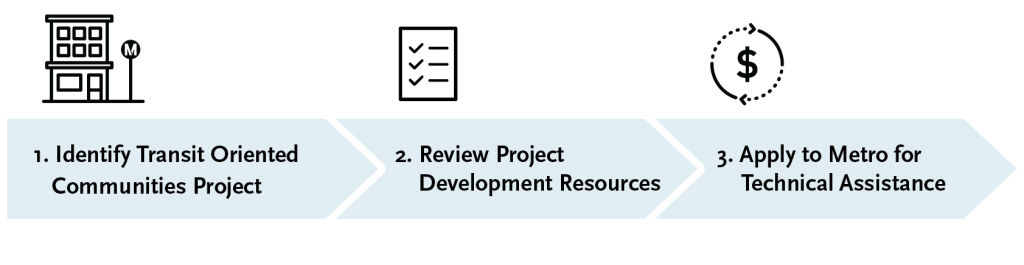
- Identify a Transit Oriented Community Project
A planning project or study proposal is eligible for Metro’s Transit Oriented Communities if it meets the following criteria:
a. Project area is located near a Major Transit Stop
Use the Eligible Project Areas map to find local project areas that qualify for this program. Qualifying projects must be located near a Major Transit Stop*.
*Major Transit Stop Definition
Major Transit Stop, per California Public Resource Code 21064.3, which may be amended from time-to-time, is defined as:
(a) An existing rail or bus rapid transit station (PRC 21060.2)
(b) A ferry terminal served by either a bus or rail transit service.
(c) The intersection of two or more major bus routes with a frequency of service interval of 20 minutes or less during the morning and afternoon peak commute periods.
Per the intent of the TOC Policy, Major Transit Stop shall also include an environmentally-cleared fixed guideway transit station. A planned fixed-guideway station may also be considered if its location is the only alternative under consideration for a transit corridor in the planning stages.
b. Project incorporates a Transit Oriented Community Activity
Eligible Transit Oriented Community Activities
Eligible studies for this program must be tied to at least one of the following core TOC Activities and located within an eligible radius of transit:
| Eligible TOC Activities | Distance from a Major Transit Stop* |
|---|---|
| Affordable Housing -Preserving affordable housing -Producing affordable housing | Within a half mile |
| Community Stabilization -Anti-displacement for residents -Anti-displacement for local businesses -Placemaking | Within a half mile |
| Regional Housing Needs Assessment, with a TOC focus -Studying policy changes to zoning, density -Utility assessment for housing development | Within a half mile |
| First/Last Mile -First/Last Mile planning assessment -First/Last mile strategy design refinement toward implementation | Within three miles |
- Review project development resources for this program
Explore resources created to support potential applicants in developing an application and project scope below.
- Template Scopes: Use a template scope as a framework to build out a project proposal
- TOC TAP Program Guidelines: Read about the program background and administrative guidelines
- Coffee with a ‘Plannerd’: Meet with Metro program staff to answer any questions on the application process
- Apply to TOC Technical Assistance Program
Applications to the TOC Technical Assistance Program will be accepted and evaluated for award on a rolling basis.
- Use the TOC Technical Assistance Program Application Worksheet to review questions, write answers and complete required application attachments.
- Copy and paste the final application answers and upload the completed attachments to the TOC Technical Assistance Program Online Application (Note answers may not save in draft mode, which is why we recommend writing the application responses in the Application Worksheet before transitioning to the online application.)
Equity is Our Priority
Metro calls on Program Recipients to incorporate equity as a process and an outcome in funding requests. Additionally, Metro will prioritize resources in Equity Focus Communities and other high-need communities, based on socio-economic factors, as deemed relevant.
Frequently Asked Questions
Review frequently asked questions here.
Additional Resources
Transit Oriented Communities Grant Writing Assistance Program
Contact Us
For general inquiries: tocimplementation@metro.net.
Want to discuss a potential project? Connect with our team over a virtual call.
